
Chicken Road Strategy: What Works, What Doesn't, and Why
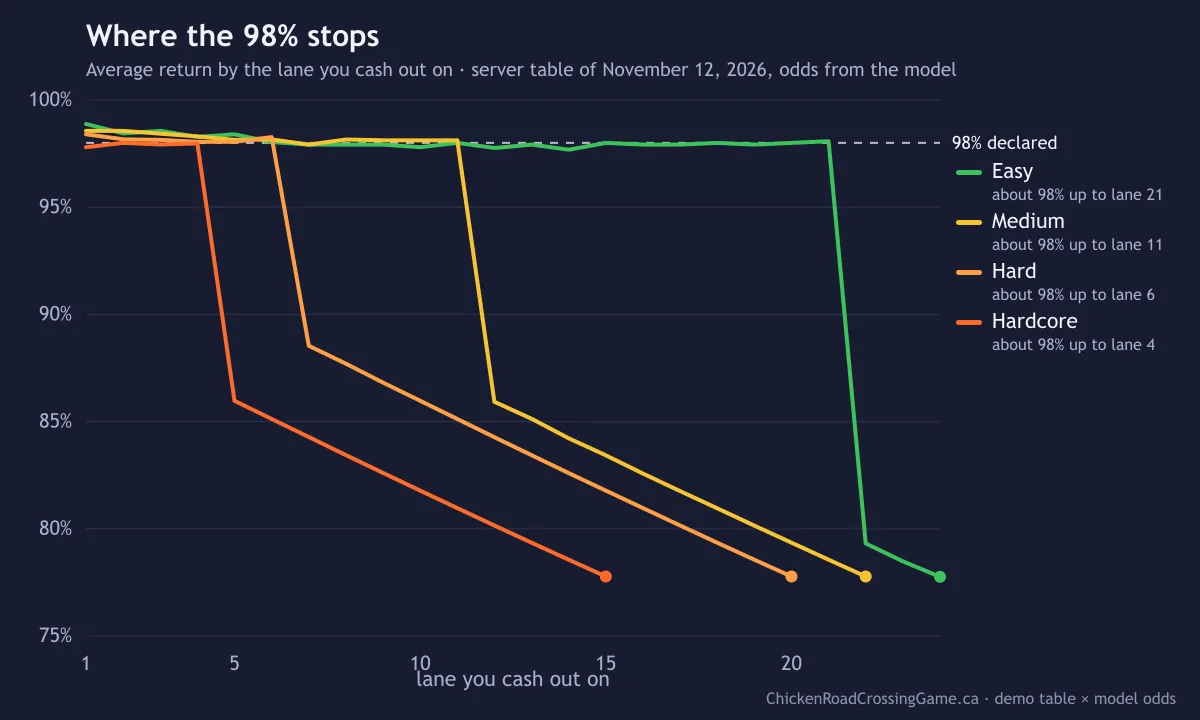
No strategy beats Chicken Road: the traps are placed by the server before you press Go, and every rule loses about 2% of stakes over time at best. What a strategy can do is choose how you lose that 2%: in small steady amounts or in rare big swings, and whether you keep the 98% at all. Below, the rules that hold up against the server's table, and the ones that don't.
In short: pick a cash-out lane inside your level's 98% zone (Easy up to 21, Medium up to 11, Hard up to 6, Hardcore up to 4), size the stake at 1–2% of the budget, and let Autoplay keep the rule. Skip Martingale, predictors and "signals".
Chicken Road strategy 1: the early cash-out
Cash out on the same early lane every round. On Medium, lane 5 (1.98x) is reached about one round in two and the rule returns about 98.1% of stakes in my model.
It is the most boring strategy and the one that keeps the declared RTP. Variations that keep it as well:
| Level | Lane | Multiplier | Reached (model) | Return |
|---|---|---|---|---|
| Easy | 10 | 1.63x | 60.0% | 97.8% |
| Medium | 5 | 1.98x | 49.6% | 98.1% |
| Medium | 11 | 6.20x | 15.8% | 98.1% |
| Hard | 3 | 1.98x | 49.6% | 98.1% |
| Hardcore | 2 | 2.80x | 35.0% | 98.0% |
Hard lane 3 and Medium lane 5 pay the same 1.98x with the same chance: two roads to one result.
Test a Chicken Road cash-out rule before you play it
Pick the level, the lane you cash out on and your stake. The sums use the demo server’s own table.
Out of 100 rounds with this rule: 50 reach the cash-out, 50 burn. On average they return C$98.1 for every C$100 staked. Here the table pays well under the declared 98%: on Medium, cash out by lane 11 to keep it. This win is capped at C$15,000 per round.
Chicken Road strategy 2: aiming for one big lane
Aim for one deep lane, say Medium lane 19 (92.17x), and accept that most rounds burn. You win about once in 115 rounds and the rule returns about 80%: you pay 18 points of RTP for the size of the hit. And remember the cap: at C$25 a round, anything above 600x is paid as C$15,000 at most.
If you like the thrill of a big multiplier, play it with a tiny stake and for a limited number of rounds, and treat the cost as the price of the show.
Chicken Road strategy 3: Martingale doubling
Double the stake after every loss so that the first win recovers everything. On paper it works; in practice it runs into the table maximum and your budget. On Medium lane 5 (a loss about half the time), eight losses in a row happen roughly once every 240 eight-round stretches, and the eighth stake is 128 times the first. Starting at C$2, the eighth stake is C$256, with C$254 already lost. And because 1.98x is just under 2x, even winning that round leaves you C$3.12 down: on this lane plain doubling never quite recovers the losses.
Martingale does not change the 98%. It turns many small wins into a rare large loss of the whole budget.
Chicken Road strategy 4: reading patterns
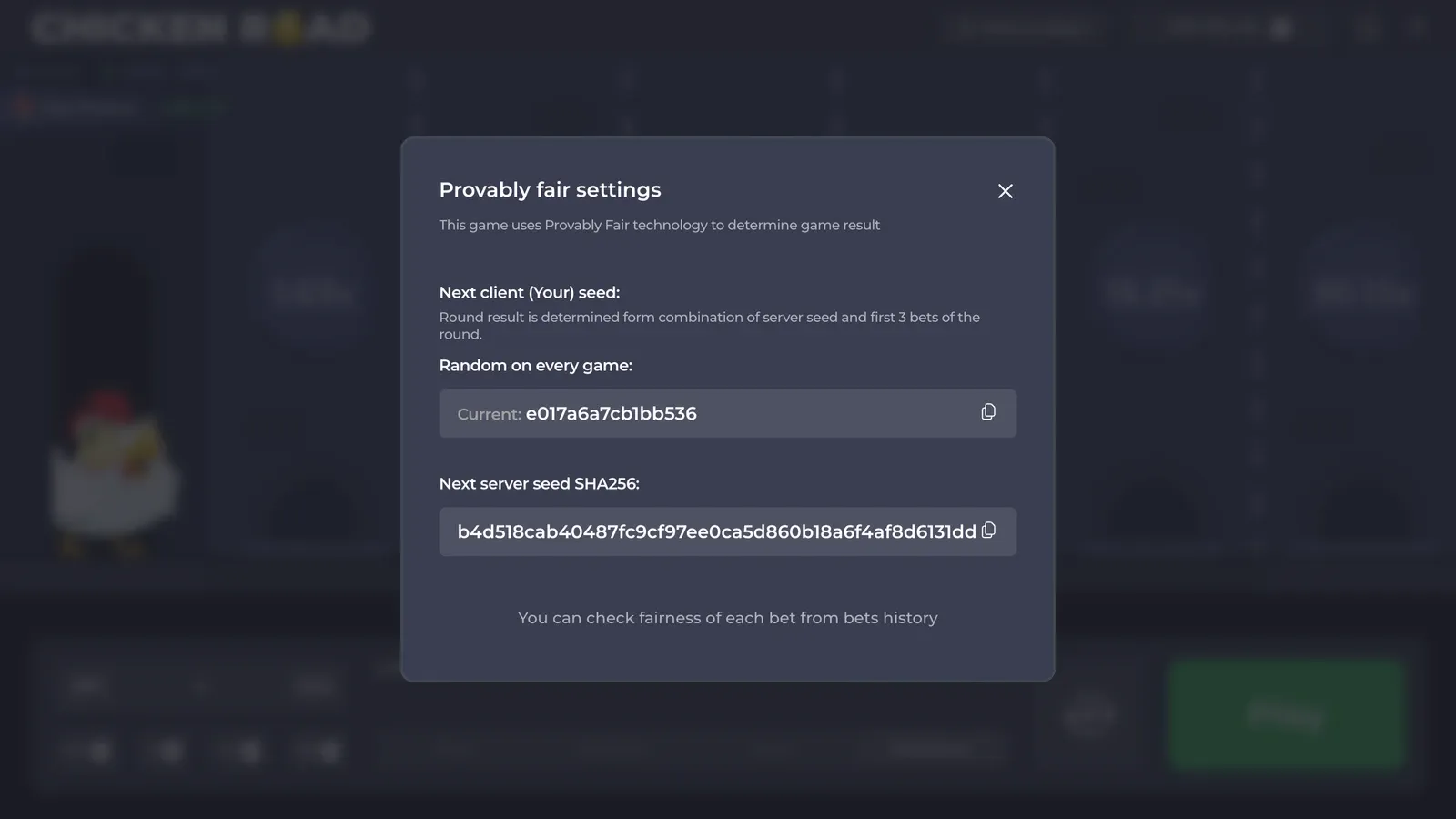
Some players skip lanes after a run of losses, or switch level after a big win. The road has no memory: each round's traps are drawn afresh, and the provably fair hash shows they are fixed before you play. A sequence of results tells you nothing about the next round.
Chicken Road predictors, bots and signals
Apps and channels that promise to show where the traps are cannot work. The positions are decided on the server and committed by a hash before the round; nothing on your phone can see them. In practice these offers make money from subscriptions, from collecting your casino login, or from affiliate links to casinos. If something needs your password or a payment to "unlock" predictions, walk away.
A Chicken Road stake plan for a C$ budget
- Budget for the session: an amount you are fine losing. Say C$100.
- Stake: 1–2% of it. C$1 to C$2.
- Rule: one level, one cash-out lane, chosen before the first round.
- Stop points: stop if the balance halves, or if it reaches a target you set (for instance +50%).
- Autoplay: 25 or 50 rounds at a time, then look at the balance and decide.
That plan does not make the game profitable. It makes the cost predictable.
Chicken Road 2 strategy: what changes
The same logic applies with a lower baseline: early lanes return about 96%, the 95.5% holds deep into each level, then falls to 75–77%. Chicken Road 2 has no Autoplay in the demo, so keeping a rule is up to your finger.
Play Chicken Road for real money
The same road as the demo, with Canadian dollars. Three numbers to know before you press the button:
19+ (18+ in Alberta, Manitoba and Quebec).
FAQ on strategy
Is there a strategy to always win at Chicken Road?
No. Each round's traps are fixed by the server before it starts. The best a rule can do is keep the declared 98% RTP, which is still a 2% cost over time.
What is the best cash-out lane?
Any lane inside your level's 98% zone: up to lane 21 on Easy, 11 on Medium, 6 on Hard, 4 on Hardcore. Within that zone the return is the same; what changes is how often you win.
Does Martingale work on Chicken Road?
It does not change the return, and a run of losses can make the doubled stake exceed your budget or the C$300 maximum.
Do Chicken Road predictors work?
No. Trap positions are decided on the server and committed by a hash before the round. Predictor apps cannot see them.
Is it better to play Easy or Hardcore?
Neither returns more if you cash out inside the 98% zone. Easy gives frequent small wins; Hardcore gives rare big ones with 40% of rounds lost on the first lane.
Your turn to play Chicken Road
You know how it works and what every lane costs. Set the budget and the cash-out lane first, then press the button.
19+ · free demo first · play responsibly